 EN
EN

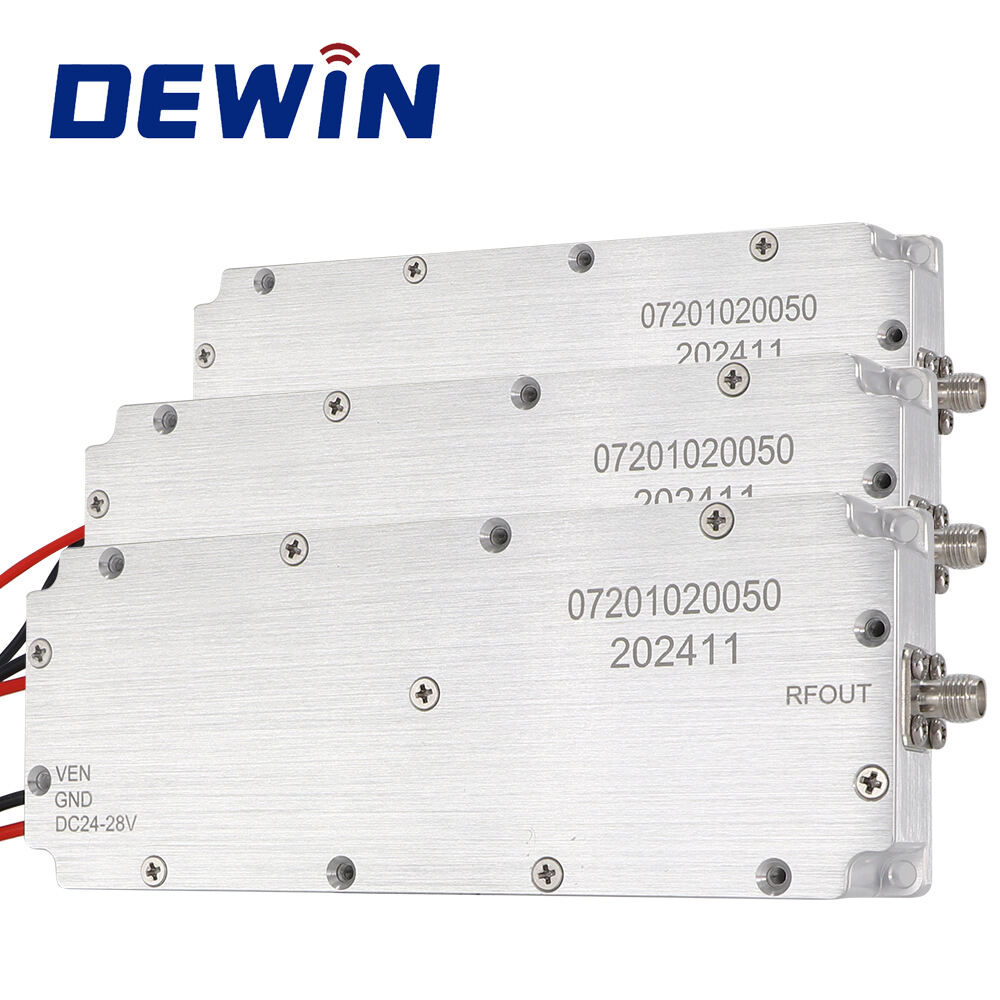
Critical RF Power Amplifier Specifications for Long-Range C-UAS Effectiveness
Output Power (100â125 W) and Its Direct Impact on Jamming Range
The amount of power output really determines how far a jammer can effectively disrupt drones. Most systems that put out between 100 and 125 watts manage to create a disruption zone around 2 to 5 kilometers wide, which works well enough for many tactical long range C-UAS missions. According to some basic radio propagation math (like what Friis came up with), if we double the power from the amplifier, we generally see about a 40% boost in reach. Going below 100 watts just doesn't give enough signal strength to overwhelm those little drone receivers when they're operating at their usual distances, particularly when there are all sorts of obstacles getting in the way or mismatched antennas causing signal loss. On the flip side, anything over 125 watts creates serious heat management problems. Run those systems hard for too long without proper cooling and components start breaking down faster than normal, which means more downtime and higher repair costs in the field.
Frequency Coverage: 500 MHzâ40 GHz for Multi-Band Drone Signal Disruption
Modern drones employ diverse, dynamically shifting communication and navigation protocolsâmaking broadband coverage from 500 MHz to 40 GHz essential. This span encompasses all major threat bands:
- 420â928 MHz: Legacy UAV command-and-control links
- 1.5â1.6 GHz: GPS/GNSS navigation and spoofing targets
- 2.4 GHz & 5.8 GHz: Primary Wi-Fi-based control and FPV video transmission
- C-band through Ka-band (4â40 GHz): Military-grade datalinks and radar-guided UAVs
Narrowband amplifiers are ineffective against frequency-hopping or multi-radio drones. To counter such adaptive threats, broadband amplifiers must support rapid spectral sweepingâideally exceeding 1 GHz/μsâto maintain uninterrupted jamming across hopping sequences.
Linearity, Efficiency, and Thermal Stability Tradeoffs in High-Power RF Power Amplifier Design
High-performance C-UAS amplifiers require careful balancing of three interdependent parameters:
- Linearity (>30 dBc ACLR): Ensures clean, distortion-free jamming waveforms during complex modulation schemes (e.g., noise-modulated or pulsed interference), preventing unintended out-of-band emissions that could interfere with friendly systems.
- Efficiency (>50% PAE): Reduces DC power draw and heat generationâcritical for battery-operated or vehicle-mounted platforms where energy budget and thermal signature matter. Advanced envelope tracking can elevate PAE to 65% while preserving linearity.
- Thermal stability (ÎT < 10°C over operating cycle): Prevents gain drift, frequency shift, and thermal runaway during extended missions. Passive cooling suffices up to ~80 W; active (e.g., forced-air or liquid) cooling is mandatory for sustained 100+ W operation.
Class AB remains the dominant architecture for its balanced performanceâbut GaN-based implementations now enable superior linearity-efficiency-thermal tradeoffs compared to legacy silicon or LDMOS.
Why Gallium Nitride (GaN) RF Power Amplifiers Dominate Long-Range Counter-UAS Applications
GaN-on-SiC Advantages: >85% Efficiency, High Power Density, and Robust Thermal Management
The military and defense sectors have largely moved toward Gallium Nitride (GaN) technology, especially when paired with silicon carbide (SiC), as their go-to solution for long range C-UAS RF power amplifiers. Why? Well, there are several reasons that make this combo so attractive. For starters, GaN components typically achieve over 85 percent power added efficiency. That means far less wasted energy, which translates into longer operational times for those mobile defense units out in the field. Another big plus is how GaN handles power density. With its ability to withstand higher voltages and move electrons faster, we can pack 100 to 125 watts worth of amplification into small, rugged boxes that soldiers can actually carry around. And let's not forget about heat management. Silicon carbide conducts heat away at an impressive rate of 490 watts per meter kelvin. This keeps things cool under pressure, maintaining signal stability even when systems run continuously during intense jamming operations. All these factors combined give operators a significant edge in controlling the electromagnetic spectrum, something older silicon or LDMOS based amplifiers just couldn't match in harsh conditions.
Broadband RF Power Amplifier Architecture for Adaptive, Long-Range Electronic Warfare
Enabling Simultaneous Jamming of 2.4 GHz, 5.8 GHz, LTE, and GNSS Bands Across Extended Ranges
For adaptive long range C-UAS operations, broadband RF power amplifiers form the backbone of effective systems. These devices offer continuous coverage from 1 to 6 GHz frequencies, which means they can disrupt both common drone control bands at 2.4 GHz and 5.8 GHz as well as LTE telemetry signals and various GNSS systems like GPS operating at 1.575 GHz, plus GLONASS and Galileo too. Traditional approaches using sequential or switched bands create problems because they introduce delays during band switching. This creates opportunities for smart drones employing frequency hopping techniques or dual radio setups to stay connected. Keeping signal linearity across such a wide spectrum range helps avoid those pesky intermodulation distortions when running several jamming signals at once. Output power between 100 and 125 watts gives enough effective radiated power to keep disrupting targets over distances exceeding 5 kilometers, even when working with average antenna gains and accounting for normal signal loss through the atmosphere. Today's electronic warfare landscape demands real spectral agility without any tradeoffs. This kind of performance isn't just nice to have anymore but has become essential if operators want reliable drone neutralization capabilities.
System-Level Integration: How RF Power Amplifier Performance Translates to Real-World C-UAS Range and Reliability
Getting good results from C-UAS systems really hinges on how well RF power amplifier specs fit into the whole system design. When we talk about output power around 100 to 125 watts, combining that with directional antennas and quality feedlines lets us reliably jam signals over distances exceeding 2 kilometers. The range actually scales depending on antenna gain and what's going on in the environment. Coverage across frequencies from 500 MHz all the way up to 40 GHz means we can suppress control signals, video feeds, and navigation bands at the same time, which takes down those tricky drones that switch between different frequencies or have backup systems. But just looking at the numbers isn't enough either. Thermal issues matter a lot too. Amplifiers tend to lose about half a decibel of power for every ten degree temperature increase at the junction point, which can cause problems during long operations. That's where GaN-on-SiC amplifiers come in handy because they handle heat better and work more efficiently. There are other important factors to consider as well. We need solid electromagnetic compatibility shielding and careful power management that keeps voltage fluctuations under five percent either way. These things together help maintain signal quality and keep the system running strong even under tough conditions. At the end of the day, what makes a difference in actual field operations isn't just having great components, it's making sure everything works together properly in real world situations.
FAQ
What is the optimal power output for jamming drones?
Typically, a power output between 100 and 125 watts is considered optimal. It effectively disrupts drones over a range of 2 to 5 kilometers.
Why is broadband coverage important in RF power amplifiers?
Broadband coverage from 500 MHz to 40 GHz is essential to disrupt the wide variety of communication and navigation protocols employed by modern drones.
How does Gallium Nitride (GaN) technology benefit RF power amplifiers?
GaN technology offers over 85% efficiency and robust thermal management, making it suitable for long-range C-UAS applications.
What are the benefits of using directional antennas in C-UAS systems?
Directional antennas enhance the jamming range, allowing signals to be jammed over distances exceeding 2 kilometers.
How do thermal issues impact RF power amplifier performance?
Thermal issues can cause power loss and affect performance. GaN-on-SiC amplifiers are advantageous as they handle heat better and ensure efficient operation.
Table of Contents
- Critical RF Power Amplifier Specifications for Long-Range C-UAS Effectiveness
- Why Gallium Nitride (GaN) RF Power Amplifiers Dominate Long-Range Counter-UAS Applications
- Broadband RF Power Amplifier Architecture for Adaptive, Long-Range Electronic Warfare
- System-Level Integration: How RF Power Amplifier Performance Translates to Real-World C-UAS Range and Reliability
-
FAQ
- What is the optimal power output for jamming drones?
- Why is broadband coverage important in RF power amplifiers?
- How does Gallium Nitride (GaN) technology benefit RF power amplifiers?
- What are the benefits of using directional antennas in C-UAS systems?
- How do thermal issues impact RF power amplifier performance?