 EN
EN

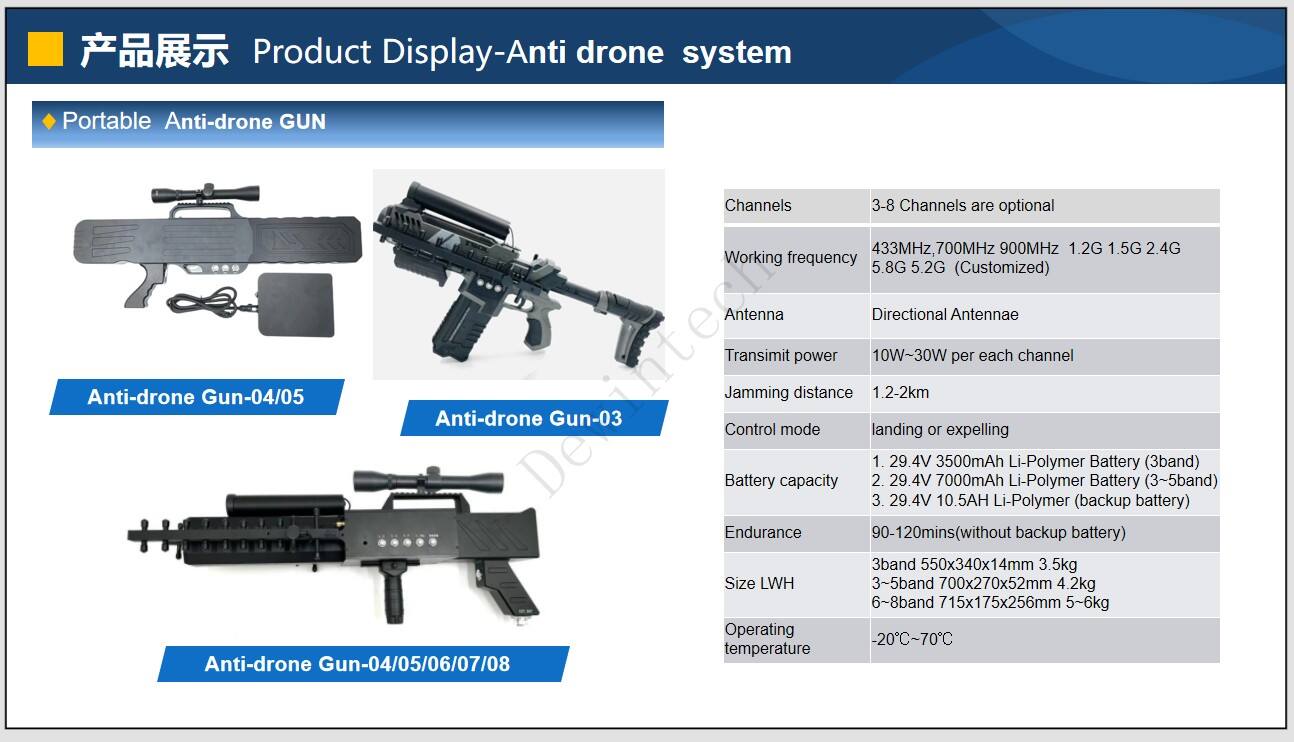
How FPV Jammer Power Levels Influence Signal Blocking Stability
FPV jammer power levels directly determine the energy available to disrupt drone control links and video feeds. Unlike standard radio frequency interference, stable FPV signal jamming requires transmitting power that exceeds both the pilot’s transmission strength and the environmental noise floor across multiple frequency bands.
How Power Levels of Signal Jammers Affect FPV Video Transmission Jamming
To mess with FPV video signals takes around 8 to 10 dB more power than just jamming control signals. The reason? Video links handle way more data and have complex modulation schemes. According to tests from RF Security Group back in 2024, when they looked at this stuff, an 80 watt jammer operating at 5.8 GHz could disrupt about 97% of video feeds within a 300 meter radius. That's pretty impressive compared to those smaller 30 watt models which only managed around 72% disruption rate. The extra power matters because it keeps the noise floor high enough to fight off something called adaptive frequency hopping. And guess what? About two thirds of all commercial FPV systems out there actually use this hopping technique specifically to avoid getting blocked by weaker jammers on the market today.
The Relationship Between Jammer Power Output and Interference Range
Each 10 dBm increase in power output triples the effective interference radius in open terrain. For instance:
- 5W jammers disrupt signals up to 150m
- 20W models extend to 450m
- 80W systems exceed 1.2km
However, this gain diminishes in urban settings where building materials attenuate signals by 15–30 dB (Building Materials RF Study 2023). Airport security teams report needing 150% more jammer power near hangars and control towers to match open-field performance due to structural shielding.
Signal Stability and Jamming Effectiveness in Real-World Conditions
The field testing done in 2024 shows something interesting about jammers. It turns out consistent power matters way more than just having high peak output. Take for example when they compared two different units. The 100 watt model with only about 5% power variation kept working properly for roughly 40% longer than a bigger 120 watt unit that had much worse stability at around 15% fluctuations, especially when temperatures changed. Most problems people run into? About 57%, give or take, come down to power dropping off after extended operation. Smart manufacturers have started tackling this issue by implementing what's called dual path amplification which helps maintain steady output levels. Some of the newer advanced models go even further with cognitive radio tech that actually adjusts power distribution based on what frequencies are being used at any given moment. This approach cuts overall energy usage by about 35% without sacrificing coverage area.
Technical Factors Determining Effective FPV Jammer Power Output
Power Amplifiers in Signal Jammers and Their Role in Effective Drone Signal Jamming
The heart of any good FPV jammer lies in its power amplifier setup. These components connect the control circuitry to the antenna system while keeping things stable regarding signal strength and matching electrical resistance properly. When it comes to top quality amps, they maintain around plus or minus 1.5 dB variation throughout the 2.4 to 5.8 GHz range. That means the jammer keeps working effectively even as those pesky drones switch between different frequency bands. Heat management matters just as much though. Good thermal designs with proper cooling solutions can actually drop operating temps anywhere from 18 to 22 degrees Celsius compared to standard units running nonstop. Specialized printed circuit boards built specifically for these high frequency jobs also help out quite a bit. Field tests show these custom PCBs reduce signal loss issues by roughly 15 to 20 percent according to Signal Shielding Research findings, making the whole system work better in real world conditions.
Transmit Power and Signal Shielding Effectiveness Correlation
The way jamming works basically follows what's called a square law when it comes to power output. If someone doubles how strong their transmission is, they end up with four times the energy density right where the target is. From actual field tests we've seen that most portable FPV jammers really need around 8 to maybe 10 watts just to mess with drone signals reliably within about a kilometer distance. Once past that point though, things get tricky because stuff in the environment gets in the way. Buildings, trees, even heavy vegetation all start eating into the signal strength. Because of these obstacles, operators typically find themselves needing somewhere between 20 and 35 percent more power just to keep the interference going effectively through such conditions.
Power Supply and Power Output Efficiency in Portable FPV Jammers
The latest generation of portable jammers has moved away from old fashioned linear regulators toward switch mode power supplies that operate at around 85 to maybe even 92 percent efficiency. That represents about a quarter better performance compared to what we saw in previous models. What makes these devices stand out is their smart battery management system which constantly tweaks voltage levels so the amplifiers keep working properly. As a result, operators get anywhere between 40 and 60 extra minutes of runtime on each charge cycle. Take a standard 6000 mAh lithium pack for instance – it can now handle those 8 watt transmissions for well over an hour and a half. For teams dealing with drone threats while on the move, this kind of extended operation time really makes all the difference in field operations.
Minimum Power Thresholds for Reliable FPV and Drone Signal Jamming
Minimum Power Levels of Wireless Signal Blockers for Reliable GPS and RF Jamming
To effectively disrupt drone GPS signals at 50 meters in open terrain, FPV jammers require a minimum of 8W output (International Journal of Counter-Drone Systems, 2023). For RF jamming across 900MHz–2.4GHz, 10W achieves 90% suppression within 200 meters–key for neutralizing surveillance drones. These thresholds account for:
- Up to 40% signal loss from reflections in urban areas
- Frequency overlap with Wi-Fi and Bluetooth devices
- Regulatory limits on permissible emissions
Case Study: Power Level Performance Comparison Across Commercial FPV Jammers
Independent testing of 12 commercial jammers highlights performance disparities:
| Power Output | Effective Range (Open Field) | GPS Disruption Time | RF Jamming Success Rate |
|---|---|---|---|
| 5W | 80m | 8s | 62% |
| 10W | 180m | 3s | 91% |
| 15W | 300m | <1s | 99% |
High-end dual-band models with 10W output and adaptive hopping achieved 98% success in real-world interception trials, though they consume three times more power than basic units.
Impact of Environmental Factors on Required Jammer Power Output
Urban deployments demand 20–35% more power than open-field operations due to signal attenuation and electromagnetic clutter. According to a 2023 material absorption study:
- Concrete walls reduce jammer effectiveness by 22dB/km
- Heavy rain (50mm/hr) degrades 2.4GHz signals by 18%
- Dense foliage cuts effective range by 33%
As a result, a 10W jammer effective at 200m in clear conditions may reach only 120m near steel-frame structures. Operators must select portable systems with adjustable power outputs to adapt to dynamic environments.
Balancing High Power and Energy Efficiency in FPV Jammers
Controversy Analysis: High Power vs. Energy Efficiency in Drone Jammers
Designing effective FPV jammers really comes down to finding that sweet spot between how much power they transmit and how efficiently they use energy. Tests show that units rated at 10 watts or higher can disrupt signals about 92% of the time in lab conditions. But these high powered devices run into serious heat problems. Thermal management research indicates that around 60% of all field failures are actually caused by overheating issues. When manufacturers try to boost power output by roughly 40%, it usually means their batteries drain about 35% faster, which isn't great for someone needing to move around. The latest models tackle this problem through something called adaptive power modulation. These systems constantly adjust their output strength depending on what signals they detect in real time. While this method definitely keeps the jamming working reliably, it manages to save somewhere between 20 and 30% energy compared to older fixed power designs. Still, there's always tradeoffs when dealing with such technical constraints.
Frequently Asked Questions
What is the minimum power required for effective FPV jamming?
For effective jamming of drone GPS signals at 50 meters, an FPV jammer needs a minimum output of 8W. For RF jamming, a power level of 10W is recommended to achieve a 90% suppression rate within 200 meters.
How does the environment affect FPV jammer performance?
Environmental factors like buildings, dense foliage, and heavy rain can significantly reduce a jammer's effective range. Urban settings typically require 20-35% more power to overcome signal attenuation and electromagnetic clutter.
Why is power consistency important for FPV jammers?
Consistent power output is crucial for maintaining effective jamming over time. Variations in power can lead to reduced performance, especially when environmental conditions fluctuate.