 EN
EN

Escalating Drone Threats to Prison Integrity and Public Safety
Contraband Delivery via Drones: A Growing Operational Crisis
Over 90% of U.S. correctional facilities now report drone incursions attempting contraband drops—a 500% increase since 2020. These unmanned aerial vehicles bypass perimeter defenses to deliver drugs, weapons, and cell phones directly to inmates. The consequences cascade through facilities: synthetic opioids like fentanyl fuel addiction epidemics, smuggled blades ignite violent confrontations, and illicit phones enable ongoing criminal enterprises. One intercepted drone payload containing $300k worth of methamphetamine illustrates the scale of this airborne supply chain. Without countermeasures, drones enable criminal networks to operate with impunity outside prison walls, turning secure zones into high-risk environments.
Drone-Facilitated Escape Attempts and External Coordination Risks
Beyond contraband, drones increasingly enable coordinated escape plots. Thermal imaging cases reveal criminals using UAVs to map facility layouts at night, while encrypted communications guide inmates during breakouts. In 2023 alone, authorities foiled 14 drone-assisted escape attempts where external operatives hovered drones to signal safe routes or dropped cutting tools. The anonymity of drone operators—often positioned miles away—complicates prosecution. This airborne coordination creates multidimensional security breaches where physical barriers become irrelevant. Implementing an anti-UAV system shifts the advantage back to corrections staff by disrupting real-time criminal collaboration.
How Anti-UAV System Provides Targeted, Layered Prison Protection
Integrated Detection, Identification, and Neutralization Capabilities
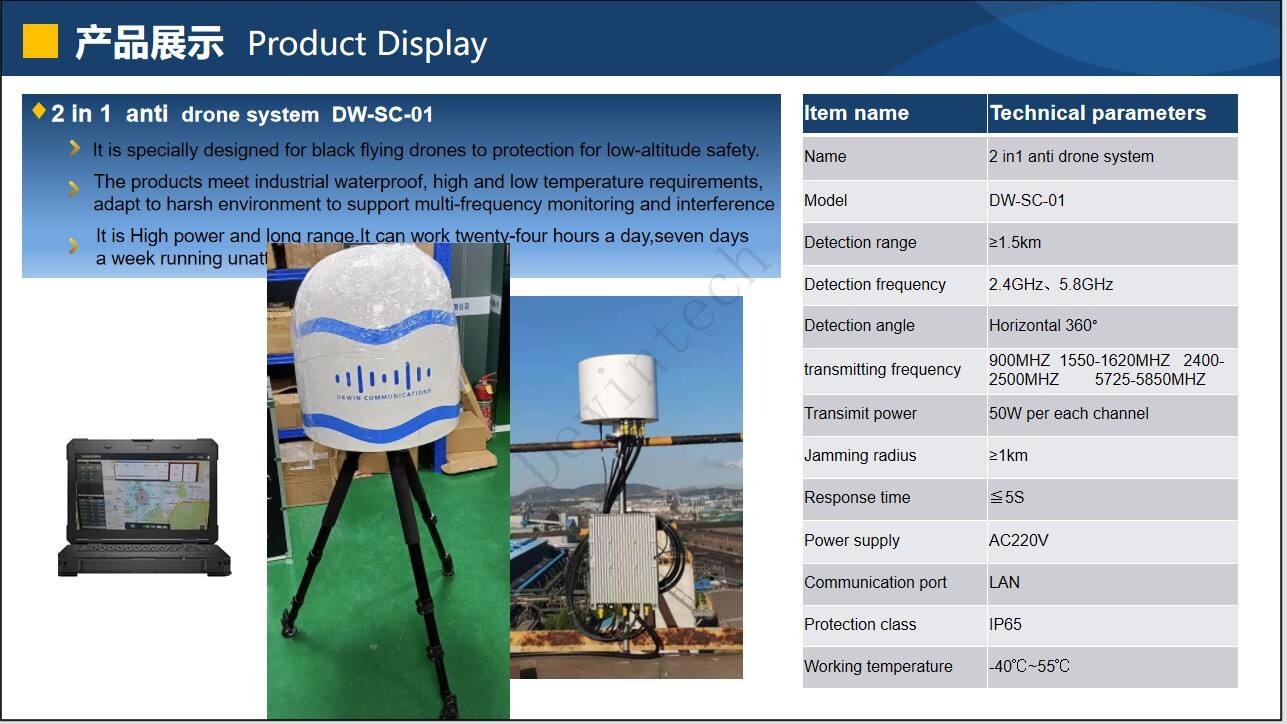
Modern anti-UAV systems employ a sequential defense methodology that begins with broad-spectrum detection using radar arrays scanning designated airspace sectors. When anomalous movement patterns are detected—such as low-altitude hovering near perimeter walls—radio frequency (RF) scanners identify specific control signals to classify drone models and operator locations. This enables security teams to distinguish between commercial drones and customized smuggling devices. The system then initiates tailored countermeasures: signal jammers disrupt operator communications for commercially available UAVs, while directed energy solutions neutralize modified drones attempting automated GPS-guided deliveries. This integrated approach addresses all threat vectors—from 97% of contraband delivery attempts using consumer drones to coordinated escape operations—while maintaining compliance with aviation regulations.
AI-Driven Radar-RF-EO/IR Fusion for Real-Time Threat Response
Advanced machine learning algorithms correlate inputs from four sensor streams: millimeter-wave radar detects objects through fog or rain, RF analyzers fingerprint transmitter signatures, electro-optical (EO) cameras provide visual confirmation, and infrared (IR) sensors track heat signatures during night operations. This multi-sensor fusion creates a unified air picture with <10-second threat verification—critical when facing swarms or high-speed drones. When Florida correctional facilities implemented such systems in 2023, response times improved by 78%, achieving successful neutralization before 95% of unauthorized drones crossed prison boundaries. This AI-powered analysis adapts to evolving tactics, recognizing new frequency-hopping patterns and autonomously prioritizing threats based on trajectory analysis toward sensitive areas like exercise yards or visitation centers.
Overcoming Deployment Barriers: Legal, Technical, and Budgetary Realities
Deploying an anti-UAV system in correctional facilities requires navigating multifaceted challenges. Regulatory compliance demands strict adherence to federal spectrum regulations (FCC Part 15) and state privacy laws, necessitating consultation with legal experts during planning phases. Technical integration complexities arise when connecting drone detection sensors with existing prison security infrastructure like CCTV networks and perimeter alarms—requiring API customization and middleware solutions. Budget constraints remain the most cited obstacle, with initial system costs averaging $200k–$500k for medium-sized facilities. However, phased implementation strategies—such as starting with critical zones like visitation areas—demonstrate 47% higher adoption success according to correctional technology studies. Forward-thinking institutions allocate funds through capital improvement programs, recognizing that preventing a single drone-delivered contraband incident (valued at $740k in operational disruption) can justify the entire investment.
The Strategic ROI of Anti-UAV System in Correctional Infrastructure
Cost-Benefit Justification: One Prevented Incident Covers Full System Investment
The financial repercussions of a single drone-assisted prison breach or large-scale contraband delivery often exceed $1 million—factoring in manhunts, legal liabilities, and facility repairs. By contrast, deploying a comprehensive anti-UAV system represents a fractional investment. Correctional facilities frequently recover the entire system cost by preventing just one major incident. This positions drone countermeasures as both a critical security layer and a fiscally sound decision. The technology delivers immediate ROI by eliminating catastrophic financial exposure while reinforcing institutional integrity.
FAQ
What are the main threats posed by drones to correctional facilities?
The main threats include contraband deliveries (drugs, weapons, cell phones), facilitating coordinated escape attempts, evading physical barriers, and mapping facility layouts with thermal imaging.
How do anti-UAV systems detect and stop unauthorized drones?
Anti-UAV systems use radar, radio frequency (RF) scanners, electro-optical (EO) cameras, and infrared (IR) sensors to detect and classify drones. They neutralize threats with tools like signal jammers and directed energy solutions.
Are there regulatory hurdles for deploying anti-UAV systems?
Yes. Facilities must ensure compliance with federal spectrum regulations (e.g., FCC Part 15) and state-specific privacy laws, often requiring expert legal consultation during implementation.
How much does an anti-UAV system cost?
Initial costs range between $200k and $500k for medium-sized facilities. However, phased implementation can make it more affordable and strategic in budget-constrained environments.
What is the return on investment (ROI) for such systems?
Preventing a single drone-related incident, which could exceed $1 million in costs, often offsets the full investment of an anti-UAV system.