 EN
EN

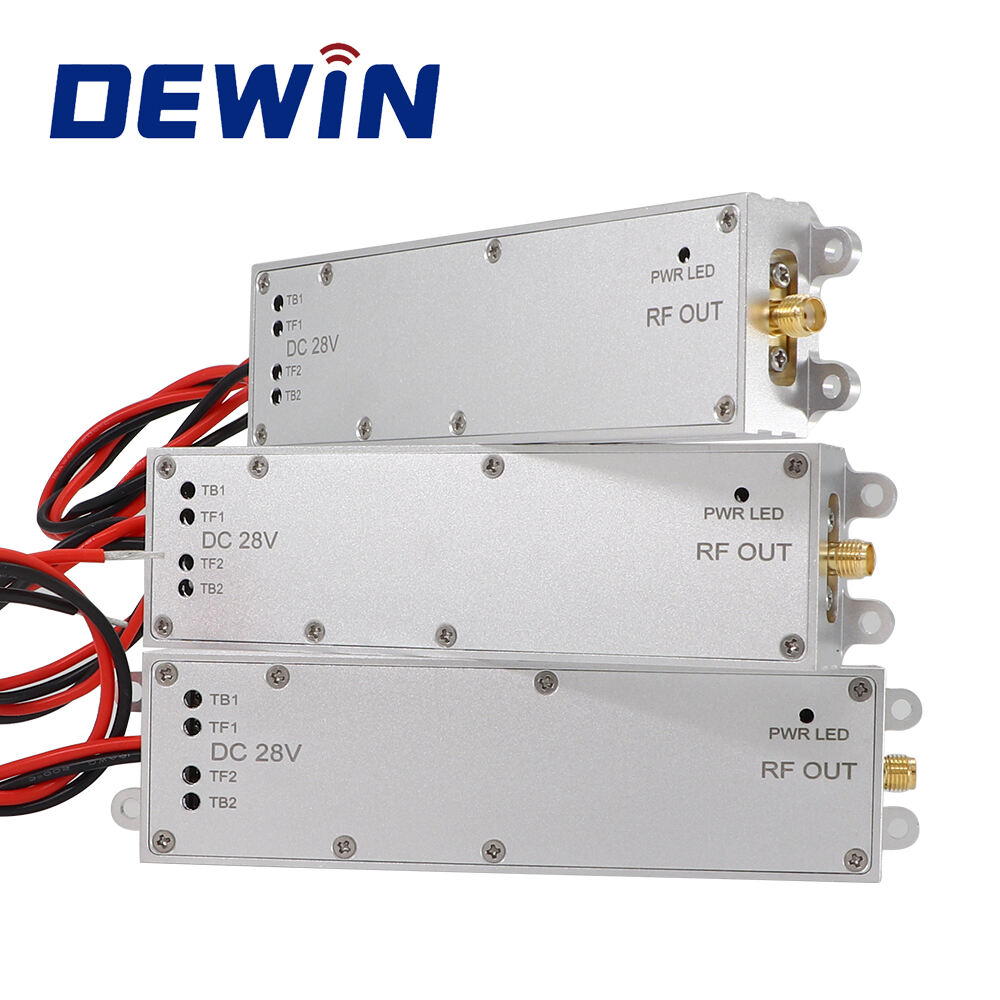
RF Power Amplifiers in Electronic Attack: Jamming and Signal Disruption
Amplifying Jamming Signals to Override Drone Control Links
RF power amplifiers act as force multipliers in electronic attack, boosting low-power jamming signals to kilowatt-level outputs capable of overwhelming drone command-and-control links. By elevating signal strength far beyond legitimate transmissions, they create a denial-of-service effect—effectively “shouting over” the operator’s commands. This disrupts telemetry, video downlinks, and navigation updates, grounding or disabling unmanned aerial systems. Tactical counter-UAS platforms typically require 100W–1kW output across 500–2500 MHz, with power-added efficiency exceeding 60% to limit thermal signature during sustained jamming. Field testing confirms that properly amplified signals achieve 95% disruption success against commercial drones at 500-meter ranges.
Frequency Coverage Requirements for Broadband RF Power Amplifiers (500–2500 MHz)
Broadband coverage from 500–2500 MHz is essential to counter evolving drone threat profiles, encompassing key operational bands:
- 900 MHz (long-range control)
- 1.2–1.6 GHz (GPS/GNSS navigation)
- 2.4 GHz (Wi-Fi-based video feeds)
Amplifiers must sustain flat gain (±1.5 dB) and high linearity across this 5:1 bandwidth ratio to preserve jamming fidelity and avoid unintended spectral spillover. Gallium Nitride (GaN) technology enables this performance—delivering 50–70% power-added efficiency and supporting instantaneous bandwidths up to 500 MHz. As noted in the 2023 Electronic Defense Review, insufficient frequency coverage accounts for 78% of fielded jamming failures, cementing 500–2500 MHz capability as a non-negotiable baseline for modern anti-drone systems.
RF Power Amplifiers in Radar-Based Detection and Tracking
Enabling High-Sensitivity Active Radar for Drone Identification
Active radar detection relies on RF power amplifiers to generate high-energy pulses capable of illuminating small, low-observable drones—many of which exhibit radar cross-sections below 0.01 m². Critical amplifier specifications include peak power output (≥5 kW), pulse-to-pulse stability (<0.5 dB variation), and robust thermal management. A 3 dB increase in transmit power, for example, doubles effective detection range against micro-drones. Modern solid-state GaN amplifiers deliver >40% power-added efficiency while maintaining wide instantaneous bandwidth across L- to S-bands (1–4 GHz). This combination of power, linearity, and spectral agility supports precise target discrimination—separating drones from birds and ground clutter—and significantly reduces false alarms in dense urban environments.
RF Power Amplifiers in High-Energy Directed Effects
GaN-Based RF Power Amplifiers for Microwave Neutralization Systems
High-energy microwave (HEMP) neutralization systems depend on RF power amplifiers to generate electromagnetic pulses strong enough to disable drone electronics non-kinetically. Gallium Nitride (GaN) amplifiers are uniquely suited for this role, offering 5–10× higher power density than legacy gallium arsenide (GaAs) devices. This allows compact, portable systems to produce field intensities exceeding 1 kW/m² at ranges beyond 100 meters—sufficient to disrupt flight controllers, IMUs, and GNSS receivers. Crucially, GaN maintains >60% power-added efficiency across 1–6 GHz, mitigating thermal throttling during repeated firing cycles. Field validation shows >90% neutralization success against commercial drones when amplifier peak gain exceeds 20 dB—making GaN the de facto standard for rapid, precision-directed effects in C-UAS operations.
Key Implementation Notes:
- Thermal management remains critical: junction temperatures must stay below 175°C to ensure consistent output and longevity
- Harmonic suppression >30 dBc is required to prevent out-of-band interference with co-located radar and comms subsystems
- Recent efficiency and packaging advances now support man-portable and vehicle-mounted form factors without sacrificing output or reliability
System Integration Challenges for RF Power Amplifiers in C-UAS Platforms
Integrating RF power amplifiers into Counter-Unmanned Aircraft Systems (C-UAS) introduces four interdependent engineering challenges. First, thermal management grows increasingly complex as high-output amplifiers operate within space-constrained, mobile, or fixed-site enclosures—demanding advanced cooling solutions like vapor chambers or liquid cold plates to avoid performance degradation. Second, frequency coordination is vital to prevent self-interference among co-located subsystems: jammers, radars, and communications must operate in spectrally isolated or time-gated modes under unified spectrum management. Third, synchronization latency between detection sensors and amplifier-based effectors must be minimized—ideally under 100 ms—to maintain engagement effectiveness against agile, low-altitude drones. Finally, SWaP (size, weight, and power) constraints in tactical platforms necessitate careful tradeoffs between amplifier output, efficiency, and physical footprint. Leading integrators address these challenges through modular architectures with standardized power/control interfaces, integrated EMC shielding, and thermally optimized interface materials—enabling reliable, interoperable deployment across layered defense ecosystems. Without such integration-focused design, amplifier reliability erodes under operational stress, risking mission failure during critical engagements.
FAQ
What role do RF power amplifiers play in electronic attack?
RF power amplifiers amplify low-power jamming signals to high-power outputs, disrupting drone control links by overpowering legitimate transmissions.
Why is broadband frequency coverage crucial for RF power amplifiers?
Broadband coverage (500–2500 MHz) ensures compatibility with various drone communication protocols, improving disruption effectiveness across a wide range of frequencies.
How do RF power amplifiers enhance radar-based detection?
They amplify radar signals to illuminate small drones, improving detection range and target discrimination, especially in cluttered environments.
What benefits does Gallium Nitride (GaN) technology provide in amplifiers?
GaN technology offers high power density, efficiency, and reliability, enabling compact solutions for jamming, detection, and high-energy neutralization of drones.
What challenges arise when integrating RF power amplifiers into C-UAS platforms?
Key challenges include thermal management, preventing subsystem interference, reducing synchronization latency, and meeting size, weight, and power constraints.
Table of Contents
- RF Power Amplifiers in Electronic Attack: Jamming and Signal Disruption
- RF Power Amplifiers in Radar-Based Detection and Tracking
- RF Power Amplifiers in High-Energy Directed Effects
- System Integration Challenges for RF Power Amplifiers in C-UAS Platforms
-
FAQ
- What role do RF power amplifiers play in electronic attack?
- Why is broadband frequency coverage crucial for RF power amplifiers?
- How do RF power amplifiers enhance radar-based detection?
- What benefits does Gallium Nitride (GaN) technology provide in amplifiers?
- What challenges arise when integrating RF power amplifiers into C-UAS platforms?