 EN
EN

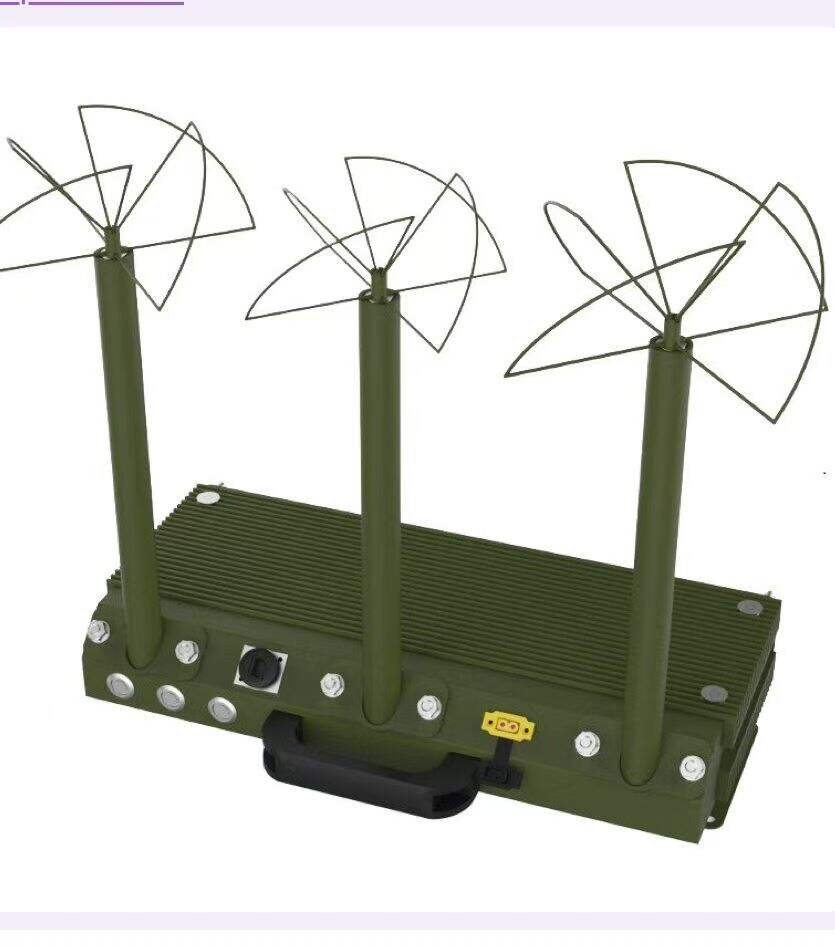
Understanding High-Gain Anti-Drone Antennas and Their Role in Long-Range Jamming
How Gain Metrics Translate to Effective Long-Range Drone Suppression
The gain of an antenna, measured in decibels isotropic (dBi), plays a major role in determining just how far those jamming signals can actually reach out to stop unwanted drones from flying around. When we talk about higher gain antennas, what happens is they focus the radio frequency energy into much narrower beams which helps combat the natural weakening of signals as they travel further distances. Antennas that are directional and have around 15 dBi typically manage to push back against rogue drones about 40% farther than their lower gain counterparts. This makes sense because these stronger signals create that necessary signal-to-noise ratio, usually above 20 dB, that cuts off communication between the drone and whoever controls it. Real world testing shows these kinds of systems can take down targets beyond 1.2 kilometers away by flooding their receivers with carefully adjusted RF noise patterns while keeping other nearby electronics from getting affected too badly.
The Trade-Off Between High Gain and Coverage Area in Anti-Drone Systems
While high-gain anti-drone antennas excel at long-range suppression, their directional nature inherently narrows the coverage cone—often below 30° beamwidth. This creates operational limitations:
- Urban environments: Physical obstructions fragment line-of-sight paths
- Moving targets: Mechanically steered antennas struggle with rapid drone maneuvers
- Multi-drone swarms: Narrow beams cannot simultaneously engage dispersed threats
Optimizing polarization alignment—particularly circular polarization matching common drone receivers—reduces signal reflection losses by 67% in cluttered areas. Strategic elevation (10m+) further extends effective radius by 1.8 by minimizing ground interference.
Comparing High-Gain Antenna Types: Parabolic, Yagi-Uda, and Phased Array for Anti-Drone Use
Effective anti-drone antenna selection balances gain, range, and operational flexibility. Directional antennas dominate long-range counter-UAS deployments due to superior signal focus.
Parabolic Antennas: Maximum Gain and Directional Precision
Parabolic dishes achieve the highest gain (>24 dBi) by concentrating RF energy into ultra-narrow beams (3°—10° beamwidth), enabling precise targeting of rogue drones beyond 5 km. Their physics-driven design minimizes signal dispersion but requires mechanical steering for target tracking.
Yagi-Uda Antennas: Cost-Effective Long-Range Jamming for Fixed Deployments
Yagi arrays offer moderate gain (12—18 dBi) with wider coverage (45°—90° beamwidth) than parabolic alternatives. Performance benchmarks show consistent jamming at 3—4 km ranges—ideal for perimeter defense. Their simple construction lowers costs by 60% compared to phased arrays, though fixed alignment limits dynamic threat response.
Phased Array Antennas: Electronic Beam-Steering and Adaptive Tracking
Phased arrays electronically manipulate beam direction without moving parts. By combining hundreds of elements, they deliver adaptive performance:
| Feature | Capability | Operational Impact |
|---|---|---|
| Gain | 15—22 dBi | Effective range: 3—8 km |
| Beam Steering Speed | <100 ms directional shifts | Real-time drone tracking |
| Beamwidth Control | 10°—60° adjustable focus | Optimized for swarm engagements |
This enables simultaneous jamming of multiple trajectories, though power consumption exceeds alternatives by 30—40%.
Beam-Steering and Real-Time Alignment in High-Gain Anti-Drone Antenna Systems
Optoelectronic Tracking Integration for Dynamic Antenna Aiming
Optoelectronic systems that combine thermal imaging with regular visible light cameras are making it possible to track down those pesky unauthorized drones in real time for high gain anti-drone antennas. These systems automatically spot and follow rogue UAVs as they move around. The magic happens when sensor fusion algorithms start matching up signals.
FAQ
What is the role of high-gain antennas in anti-drone systems?
High-gain antennas focus radio frequency energy into narrow beams, allowing them to effectively jam signals over long distances.
What are the limitations of high-gain, directional antennas?
Though effective for long-range, these antennas have a narrow beamwidth, which limits their coverage area and makes them susceptible to obstructions.
How do phased array antennas differ from other types?
Phased array antennas can electronically steer their beam without moving parts, allowing real-time tracking and multiple target engagements.