 EN
EN

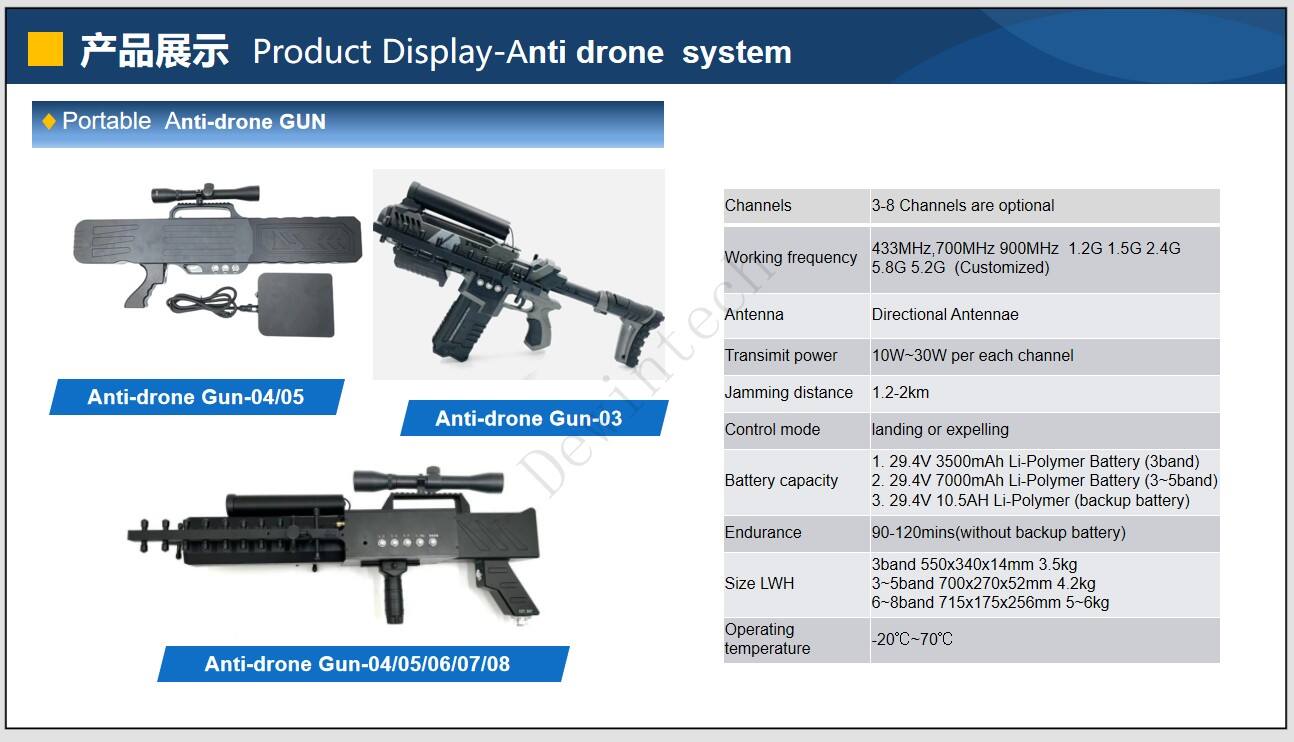
How Anti-UAV Systems Use RF Jammers to Disrupt Drone Communications
Today's anti-drone defenses rely heavily on radio frequency (RF) jammers that basically mess with or shut down the important communication channels connecting drones to their controllers. Most of these systems focus on the 2.4 GHz and 5.8 GHz ISM bands where most consumer drones operate for both control signals and live video feeds. The really sophisticated setups go after other frequencies too, like 433 MHz and 915 MHz, which helps stop those FPV racing drones and DIY creations that don't stick to regular frequency ranges. When these jammers blast out strong interference signals across those specific bands, they create enough signal chaos that most rogue drones either have to land immediately or fly back to where they took off from, depending on how smart their onboard systems are programmed to handle such situations.
Key Frequency Bands Used in Detection, Tracking, and Mitigation of UAVs
Effective anti-drone operations require coverage across several primary frequency ranges:
| Frequency Band | Purpose | Mitigation Method |
|---|---|---|
| 400–700 MHz | Long-range control (military drones) | Directional jamming |
| 900 MHz–1.3 GHz | Telemetry data links | Signal overpowering |
| 2.4–2.483 GHz | Wi-Fi-based control | Spoofing & packet injection |
| 5.725–5.875 GHz | HD video transmission | Bandwidth saturation |
A 2023 Ponemon Institute study found that systems supporting multi-band jamming reduce unauthorized drone intrusions by 78% compared to single-band solutions, highlighting the importance of broad spectral coverage in real-world deployments.
Why Customizable Frequency Ranges Improve Operational Flexibility and Mission Success
The ability to customize anti-drone systems gives operators real flexibility when dealing with constantly changing drone tech, especially since around a third of bad guys' drones these days use those tricky frequency hopping methods. Modern systems with adjustable range settings can switch pretty fast between tackling 433 MHz FPV drones during a sports event and stopping bigger 1.5 GHz military style UAVs at border crossings. We've seen this kind of system cut down on accidental alerts by almost two thirds in busy radio environments such as cities, based on what security experts have found in their reports. Plus, these systems stay within legal limits for radio frequencies where they operate.
Software-Defined Radio (SDR) for Real-Time Frequency Reconfiguration
How SDR Enables Adaptable Frequency Response in Modern Anti-Drone Systems
Software Defined Radio or SDR is changing how we deal with UAV threats by swapping out rigid hardware components for flexible software based signal processing. Traditional jamming equipment just doesn't cut it anymore against modern drones. With SDR systems, operators can actually change frequencies on the fly to keep up with new drone communication methods. About two thirds of all commercial drones these days employ some form of frequency hopping that makes them harder to detect and disrupt. What really matters though is this flexibility. Instead of spending big bucks on new hardware every time there's an upgrade needed, security teams simply download fresh software updates. This means longer lasting systems that stay effective even as drone technology keeps advancing at breakneck speed.
Dynamic Spectrum Access Through Intelligent Detection and Jamming Modules
Modern SDR setups bring together spectrum analyzers along with AI powered detection tools to scan frequency bands in real time. These systems work pretty well when they incorporate cognitive radio concepts, letting them find out which frequencies are busy and then direct jamming efforts where needed most. Take for instance how one SDR platform might watch both the 1.2 GHz range typically used by military drones and also keep an eye on 5.8 GHz frequencies common among hobbyist quadcopters, focusing countermeasures according to what represents the bigger risk at any given moment. Studies indicate that mixing different SDR approaches cuts down on those annoying false alarms by about 40 percent over traditional fixed jammers, making operations safer across complicated radio landscapes.
Processing Latency and Integration Challenges in SDR-Based Anti-UAV Deployments
SDR definitely brings something special to the table with its flexibility, but getting good performance means keeping those processing delays as low as possible. Top notch systems can get down to under 2.8 milliseconds for responses when they use those fancy FPGA parts and really clean up their DSP work. Still, bringing SDR together with older radar setups and optical tracking gear is no small task. A recent defense report from 2023 showed about one third of all anti-drone installations ran into trouble making different sensors talk to each other properly during field tests. Getting these systems to work well together basically needs everyone to agree on standard ways for devices to communicate plus some solid software in between that handles all the messy details nobody wants to deal with directly.
Real-World Case Studies: Configurable Frequency Use in Critical Infrastructure Protection
In 2022 when they upgraded their security measures, a power station somewhere in Europe installed this SDR based tech to stop those pesky reconnaissance drones from snooping around. What makes it interesting is how the system would switch back and forth between blocking signals at 900 MHz for older drones and 2.4 GHz frequencies used by GPS guided ones. According to some research from the Ponemon Institute, this approach managed to neutralize threats about 87 percent of the time. These kinds of flexible defense systems work really well in cities because there are so many other gadgets operating on similar frequencies like those unlicensed 5.8 GHz devices that might get in the way or even hide what's going on with potentially dangerous drones flying nearby.
Multi-Band Jamming and Frequency Hopping Techniques
Countering Diverse Drone Protocols with Multi-Band Operations and Frequency Hopping
Today's anti-drone systems tackle sophisticated threats by combining multi-band jamming with the ability to mess with frequency hopping spread spectrum (FHSS) signals. Both commercial drones used for delivery services and those operated by hostile actors rely on their own secret protocols within the ISM radio bands, which means these defense systems need to adapt quickly. Some drones can hop frequencies as fast as 1,000 times every second, so the anti-drone tech has to detect and respond almost instantly, ideally within about 50 millionths of a second before the drone can reconnect. Meeting this requirement is no small feat. The systems typically use FPGA chips for real time spectrum analysis and employ several different jamming strategies including barrage attacks that flood all frequencies at once, sweeping techniques that move across bands, and follower methods that track specific signals. These approaches help block control signals while minimizing unwanted interference with other nearby communications.
Simultaneous Jamming Across ISM Bands: 900 MHz, 1.2 GHz, 2.4 GHz, and 5.8 GHz
Effective anti-drone operations rely on simultaneous coverage of key ISM bands:
| Band | Primary Threat Type | Jamming Power Requirement |
|---|---|---|
| 900 MHz | Long-range telemetry systems | 10-30 W |
| 2.4 GHz | Wi-Fi/Bluetooth-controlled drones | 20-50 W |
| 5.8 GHz | HD video transmission links | 30-60 W |
Field tests show dual-band jamming (2.4+5.8 GHz) reduces drone penetration rates by 92% in urban environments compared to single-band systems, underscoring the value of coordinated multi-frequency engagement.
Avoiding Interference Through Adaptive Channel Switching in Dense RF Environments
Modern anti-drone systems rely on something called cognitive channel scanning to keep from messing up regular wireless networks out there. These systems basically check what frequencies are being used in really short intervals, sometimes as brief as under 100 microseconds. When they spot an active channel, they can shift their jamming signals away from it. This matters a lot in busy urban environments where airspace gets crowded fast. According to last year's Air Traffic Safety Report, nearly four out of five mid-air incidents happen because different devices end up fighting over the same radio frequencies. The whole point of this adaptive approach is to stop unwanted drones while keeping cell service, Wi-Fi, and other critical communications running smoothly for everyone else around.
AI and Cognitive Radio for Intelligent Frequency Adaptation
Cognitive radio technology enabling autonomous frequency selection in anti-UAV systems
Cognitive radio tech gives anti-drone systems the ability to find weaknesses in how drones communicate. These systems can scan around 120 different frequencies every second, picking up strange radio signals that suggest a drone is nearby about 94 times out of 100 according to the latest RF Defense data from 2024. The software behind them lets operators change jamming settings on the fly, so they can adjust between frequencies starting at 400 MHz all the way up to 6 GHz depending on what mission they're dealing with. Why does this matter? Because many bad actors use frequency hopping techniques to avoid detection. According to NATO's report from last year, almost 6 out of 10 hostile drones detected actually used this kind of hopping strategy.
Machine learning models predicting drone command-link behavior from spectral data
Anti-drone systems now use deep neural networks that have been trained on around quarter of a million radio frequency signatures. These advanced systems can actually guess where a drone will jump to next in its frequency hopping pattern about 8 out of 10 times. Recent research from last year showed something pretty interesting too machine learning cuts down those annoying false alarms by almost half when compared to older methods that just set fixed thresholds for detection. The real magic happens when these smart algorithms look at how signals change over time, track variations in power levels, and watch the timing between pulses. This lets operators spot stealthy drones moving around long before anyone can actually see them with the naked eye.
Real-time spectrum sensing and decision-making in smart anti-drone platforms
Advanced systems process spectrum data in less than 20 ms using FPGA accelerators. Cognitive engines follow a three-stage workflow:
- Spectrum sensing: Identifies active UAV signals across 100 MHz bandwidths
- Threat prioritization: Scores detected signals using a 12-point severity matrix
- Adaptive jamming: Deploys targeted interference while maintaining <1% impact on legitimate communications
Recent research shows these hybrid architectures achieve 98% UAV neutralization rates in urban environments with dense RF clutter, demonstrating the efficacy of intelligent, integrated approaches.
Balancing AI reliance with security: Risks of over-automation in frequency-critical operations
AI definitely makes things faster and more accurate, but when we go too far with automation, bad stuff can happen. One big problem is something called adversarial spoofing attacks where hackers mess with how frequencies get selected by the system. According to the 2023 Counter-Drone Security Audit, around 3 out of 10 AI systems got fooled into basically ignoring enemy drones because someone was messing with their radio signals. Smart folks working on these systems have started adding humans into the mix for checking frequency authorizations and running those fancy crypto signature checks on the spectrum analysis parts. The military has taken this approach even further, mixing machine learning power with actual people watching over things. Their tests show these hybrid systems solve threats about 60% quicker compared to completely automatic setups, though there are still some edge cases where even this combo falls short sometimes.
FAQ
What are RF jammers used for in anti-drone systems?
RF jammers are used to disrupt communication between drones and their controllers, primarily focusing on the 2.4 GHz and 5.8 GHz ISM bands and extending to other frequencies like 433 MHz and 915 MHz.
What is the significance of multi-band jamming?
Multi-band jamming enhances anti-drone systems by increasing spectral coverage, reducing unauthorized drone intrusions by 78% compared to single-band solutions.
How does Software-Defined Radio (SDR) improve anti-drone systems?
SDR allows real-time frequency reconfiguration, enabling adaptability to evolving drone technologies without the need for new hardware, thus maintaining system effectiveness.
What role does AI play in frequency adaptation for UAV defense?
AI, coupled with cognitive radio technology, enables intelligent frequency selection and predictive modeling to effectively neutralize UAV threats while minimizing false alarms.
Table of Contents
- How Anti-UAV Systems Use RF Jammers to Disrupt Drone Communications
- Key Frequency Bands Used in Detection, Tracking, and Mitigation of UAVs
- Why Customizable Frequency Ranges Improve Operational Flexibility and Mission Success
-
Software-Defined Radio (SDR) for Real-Time Frequency Reconfiguration
- How SDR Enables Adaptable Frequency Response in Modern Anti-Drone Systems
- Dynamic Spectrum Access Through Intelligent Detection and Jamming Modules
- Processing Latency and Integration Challenges in SDR-Based Anti-UAV Deployments
- Real-World Case Studies: Configurable Frequency Use in Critical Infrastructure Protection
- Multi-Band Jamming and Frequency Hopping Techniques
-
AI and Cognitive Radio for Intelligent Frequency Adaptation
- Cognitive radio technology enabling autonomous frequency selection in anti-UAV systems
- Machine learning models predicting drone command-link behavior from spectral data
- Real-time spectrum sensing and decision-making in smart anti-drone platforms
- Balancing AI reliance with security: Risks of over-automation in frequency-critical operations
- FAQ